Won t Tell SVG: A Designer’s Take on Bold, Minimal Embroidery
As an embroidery designer who has spent years digitizing patterns and testing them on everything from delicate baby onesies to heavy canvas tote bags, I have learned that the best designs are often the simplest. When I first pulled up Won t Tell,svg Quote in my design software, my immediate reaction was one of appreciation for its clean lines and assertive personality. In a market flooded with overly complex floral motifs and dense illustrative graphics, this piece stands out because it relies on typography and negative space to do the heavy lifting. It is not just a graphic; it is a statement.
This review comes from the perspective of someone who needs to know if a file will actually work in a real-world production environment. I am not looking at this merely as a digital asset for a mockup, but as a potential machine embroidery design that needs to hold up under the needle. Whether you are an Etsy seller looking to expand your Print Templates library or a hobbyist making a personalized gift, understanding how this specific quote translates from screen to fabric is crucial.
The Visual Personality and First Impressions
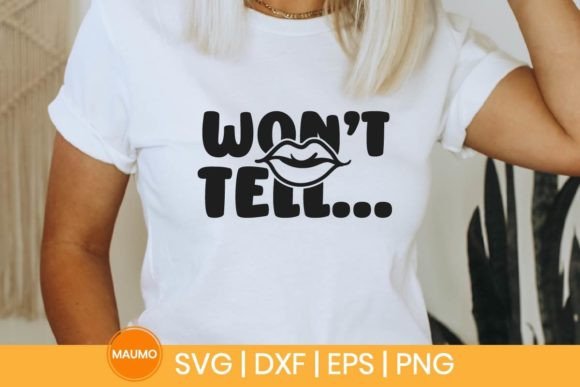
The phrase "Won't Tell" carries a playful, secretive vibe. It suggests inside jokes, confidential secrets, or a cheeky refusal to spill the tea. Visually, the design likely features bold, sans-serif or slightly stylized lettering that prioritizes readability. For embroidery, this is a double-edged sword. Bold letters are generally easier to stitch cleanly than intricate scripts, but they require careful management of stitch density to avoid puckering the fabric.
When I evaluate Graphics like this, I look at the balance between the text weight and the surrounding space. This design feels modern and versatile. It does not scream "holiday" or "baby," which means it has a longer shelf life in a small shop product lineup. It fits naturally into categories like custom apparel for teens and adults, quirky home decor, or accessories for people who appreciate dry humor. The mood is confident and slightly mysterious, making it an excellent candidate for items meant to spark conversation.
Real-World Application: From Screen to Stitch
Let’s imagine a practical scenario. You are preparing a batch of canvas tote bag design prototypes for a local craft fair. Canvas is a sturdy fabric, but it can be unforgiving if the digitizing is off. If you were to apply Won t Tell,svg Quote here, you would likely need to use a cutwork or applique technique if the letters are large, or a dense satin stitch if they are smaller. Since the product description notes this is an SVG and DXF file intended for cutting machines like Cricut or Silhouette, many embroiderers will use these files to create heat-transfer vinyl (HTV) applications or fabric appliques rather than direct stitching.
If you are using this as an applique pattern, the process becomes much more manageable. You would hoop your stabilizer and fabric, stitch the placement line, lay down your contrasting fabric, tack it down, and then stitch the bold outline of the quote. This method reduces the amount of thread on the back of the garment, making it more comfortable for wearables like sweatshirt embroidery projects. The result is a crisp, professional look that appeals to buyers who want high-quality handmade products.
For those attempting to digitize this SVG directly into an embroidery file for machine stitching, pay close attention to the corners of the letters. Sharp angles in text can cause thread breaks or bird-nesting if the turn stitches are not properly programmed. A running stitch border might be too flimsy for a frequently washed item, so consider a narrow satin stitch column for the letter edges to ensure durability.
Fabric Considerations and Technical Challenges
Not every fabric is a good match for every design. With Won t Tell,svg Quote, the primary concern is contrast and stability. On dark fabrics, you will need high-contrast thread colors to make the text pop. White or metallic threads on navy or black cotton work beautifully. However, on textured fabrics like terry cloth towels or fuzzy fleece, fine details can get lost. If the letters are thin, they may sink into the pile of the fabric. In such cases, using a tear-away stabilizer on top of the fabric (top-stabilizing) can help keep the stitches visible and clean.
Stretchy fabrics present another challenge. If you are planning to put this on a jersey t-shirt or a baby onesie, you must use a cut-away stabilizer. Knits stretch, and if the stabilizer does not support the stitch area, the text will distort after the first wash. For baby embroidery, comfort is key, so ensure that the back of the stitching is covered with a soft backing or that the design is small enough not to feel stiff against sensitive skin.
Curved surfaces, such as caps or hats, require extra caution. The center front of a cap is a small, curved area. If the quote is too wide, it will wrap around the curve and become unreadable. Always check the dimensions of the design against your hoop size before starting. If the design is too large for a standard cap hoop, consider scaling it down or moving it to a flat panel hat where you have more room.
Commercial Viability and Brand Consistency
For commercial embroidery professionals and craft business owners, consistency is vital. This design offers a strong branding opportunity because it is short and memorable. It works well as part of a series—perhaps paired with other short, punchy phrases. When creating printable mockup images for your online store, ensure that the lighting highlights the texture of the stitches. Buyers of digital embroidery file products or finished goods want to see the quality of the work.
However, a word of caution regarding licensing. The product description states you receive an SVG and DXF file. These are typically vector formats used for cutting, not native embroidery formats like PES or DST. Before selling finished items, you must confirm the license terms. Does the creator allow commercial use of the design when stitched out? Or is it strictly for personal use? Always clarify this with the seller. If you are digitizing it yourself from the SVG, ensure you have the rights to create and sell the resulting embroidery pattern.
Practical Designer Notes for Best Results
To get the most out of Won t Tell,svg Quote, follow these practical steps before committing to your final fabric:
- Test on Scrap Fabric: Always run a test stitch-out on the same type of fabric you plan to use for the final product. This reveals issues with tension and density.
- Check Thread Contrast: View your design in black and white on your screen. If the text disappears, it will likely lack impact when stitched. Choose thread colors that stand out against the background.
- Review Stitch Density: If digitizing, keep the density moderate. Too many stitches in a small area will cause the fabric to pucker and the design to look bulky.
- Confirm Hoop Size: Measure the design dimensions. Ensure it fits comfortably within your hoop with enough margin for the frame to grip the fabric securely.
- Inspect Small Details: Zoom in on the vector file. Are there any stray nodes or overlapping paths? Clean up the SVG before importing it into your digitizing software or cutting machine.
- Use Proper Stabilizer: Match the stabilizer to the fabric. Cut-away for knits, tear-away for wovens, and wash-away for delicate or sheer fabrics.
In conclusion, Won t Tell,svg Quote is a versatile, modern asset that bridges the gap between digital crafting and traditional embroidery. Its strength lies in its simplicity and attitude. By paying attention to fabric choice, stabilization, and technical execution, you can transform this simple graphic into a high-value finished product that resonates with customers. Whether it ends up on a cozy pillow, a rugged tote, or a stylish sweatshirt, this design has the potential to be a standout piece in your creative portfolio.